
Quick start
Related information
Main classes
The minimum requirement is to implement two classes, one for the service declaration and one for the implementation itself.
Hello world
The sample is a dataset user service that simply displays a "hello" message, it can be launched from the action menu of a dataset:
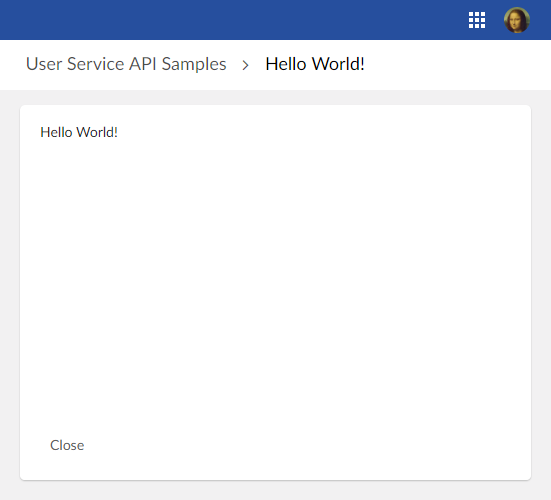
The service implementation class must implement the interface
UserService<DatasetEntitySelection>:
/**
  * This service displays hello world!
  */
 public class HelloWordService implements UserService<DatasetEntitySelection>
 {
     public HelloWordService()
     {
     }

     @Override
     public void setupDisplay(
         UserServiceSetupDisplayContext<DatasetEntitySelection> aContext,
         UserServiceDisplayConfigurator aConfigurator)
     {
         // Set bottom bar
         UIButtonSpecNavigation closeButton = aConfigurator.newCloseButton();
         closeButton.setDefaultButton(true);
         aConfigurator.setLeftButtons(closeButton);

         // Set content callback
         aConfigurator.setContent(this::writeHelloWorld);
     }

     private void writeHelloWorld(
         UserServicePaneContext aPaneContext,
         UserServicePaneWriter aWriter)
     {
         // Display Hello World!

         aWriter.add("<div ");
         aWriter.addSafeAttribute("class", UICSSClasses.CONTAINER_WITH_TEXT_PADDING);
         aWriter.add(">");
         aWriter.add("Hello World!");
         aWriter.add("</div>");
     }

     @Override
     public void setupObjectContext(
         UserServiceSetupObjectContext<DatasetEntitySelection> aContext,
         UserServiceObjectContextBuilder aBuilder)
     {
         // No context yet.
     }

     @Override
     public void validate(UserServiceValidateContext<DatasetEntitySelection> aContext)
     {
         // No custom validation is necessary.
     }

     @Override
     public UserServiceEventOutcome processEventOutcome(
         UserServiceProcessEventOutcomeContext<DatasetEntitySelection> aContext,
         UserServiceEventOutcome anEventOutcome)
     {
         // By default do not modify the outcome.
         return anEventOutcome;
     }
 }
The declaration class must implement the interface
UserServiceDeclaration.OnDataset:
/**
  * Declaration for service hello world!
  */
 public class HelloWorldServiceDeclaration implements UserServiceDeclaration.OnDataset
 {
     // The service key identifies the user service.
     private static final ServiceKey serviceKey = ServiceKey.forName("HelloWorld");

     public HelloWorldServiceDeclaration()
     {
     }

     @Override
     public ServiceKey getServiceKey()
     {
         return serviceKey;
     }

     @Override
     public UserService<DatasetEntitySelection> createUserService()
     {
         // Creates an instance of the user service.
         return new HelloWordService();
     }

     @Override
     public void defineActivation(ActivationContextOnDataset aContext)
     {
         // The service is activated for all datasets instanciated with
         // the associated data model (see next example).
     }

     @Override
     public void defineProperties(UserServicePropertiesDefinitionContext aContext)
     {
         // This label is displayed in menus that can execute the user service.
         aContext.setLabel("Hello World Service");
     }

     @Override
     public void declareWebComponent(WebComponentDeclarationContext aContext)
     {
     }
 }
In this sample, the user service is registered by a data model. The data model needs to define a schema extension that implements the following code:
public class CustomSchemaExtensions implements SchemaExtensions
 {
     @Override
     public void defineExtensions(SchemaExtensionsContext aContext)
     {
         // Register the service.
         aContext.registerUserService(new HelloWorldServiceDeclaration());
     }
 }
For details on the declaration of schema extensions, see
SchemaExtensions.